PyGrow Application Guide
PyGrow as a Biostimulant
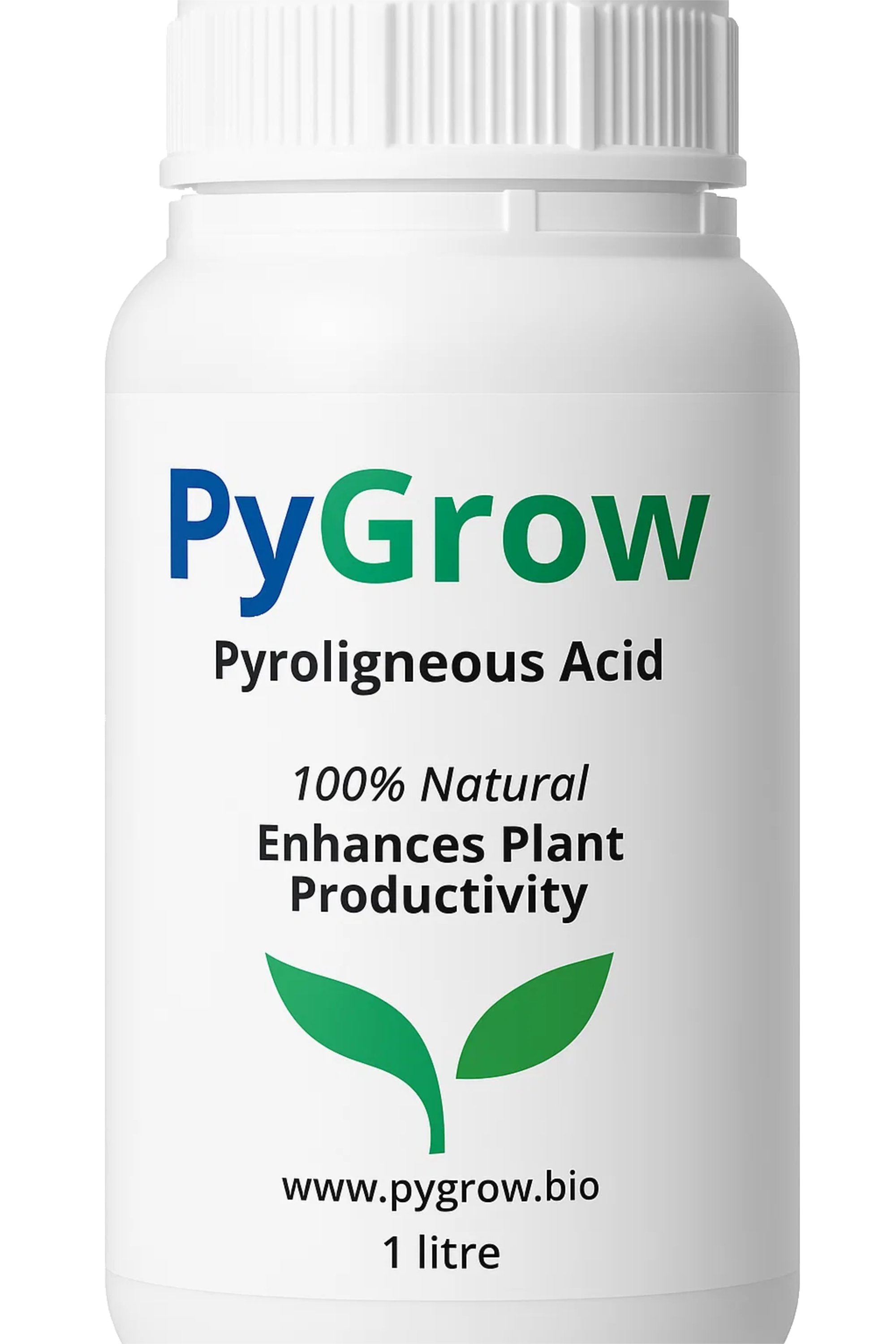
PyGrow is a biostimulant-optimized pyroligneous acid — a unique liquid extract derived from biomass.
All plant life today descends from ancestors exposed to countless wildfires over 800 million years of evolution. During periods when Earth was significantly hotter, these fires were likely quite frequent. The species that survived were those that responded to fire residues in their environment by accelerating reproduction — producing more seeds to ensure the next generation's survival. Today's plants carry this genetic imprint, and PyGrow allows us to leverage it as a practical, organic, and economical tool for improving crop yields.
Plants are highly sensitive to these smoke-derived molecules — a trace amount is enough to trigger an epigenetic signal: there's been a fire. They respond by upregulating photosynthesis, increasing sugar and metabolite concentrations in their sap, and producing more foliage, flowers, fruits — and therefore seeds. They also release greater quantities of root exudates into the soil, nourishing and signalling the microbial community in their root zone.
Plant-associated microbes, which co-evolved with plants under fire stress, respond in kind: fixing atmospheric nitrogen, solubilizing bound mineral nutrients, and making them available for uptake. It would not be surprising to discover that plants are in effect communicating with their microbial partners: there's been a fire — we need these specific soluble nutrients to produce more seeds and survive. The observed outcomes — measurable productivity gains requiring significant nutrient mobilization, and elevated soil organic matter — suggest this is a coordinated, community-wide response between plants and soil microbes.
PyGrow as a Chelation Agent to Make Nutrients Plant-Available
PyGrow contains a variety of organic acids, primarily acetic acid. These acids bind to mineral nutrients that might be added to a PyGrow mixture, keeping them plant-available for direct absorption through the seed coat, leaf surface, or root zone. This gives PyGrow a dual function: it acts simultaneously as an epigenetic signal to upregulate productivity and as a chelation agent to make nutrients optimally plant-available.
Consider combining diluted PyGrow with any essential macro or micronutrients needed to support photosynthesis, fruit, vegetable or grain development, disease resistance, etc. Our in-house trial experience suggests this can be a highly effective approach, particularly for seed priming and foliar applications to address micronutrient imbalances.
PyGrow as a Pesticide
Note: PyGrow is not currently registered as a pesticide in any jurisdiction. The following describes research findings and observed effects on pyroligneous acid (PA) generally, and does not constitute a pesticide claim.
Research has shown that PA is a natural, organic pesticide that may be effective against a variety of insects and fungi. In the case of smaller insects without a hard exoskeleton, PA exposure increases osmotic pressure within them, causing dehydration, cellular damage, and system failure. Since insects are unlikely to develop resistance to this mode of action, PA may be particularly effective against insects that have already developed resistance to synthetic pesticides. Potential applications span a variety of crops, including fruits, vegetables, and grains, as well as livestock — for example, controlling mite infestations in chickens.
PA is also a natural, organic fungicide that may be effective against a variety of fungal diseases, particularly when susceptible plants are treated early in their lifecycle before any signs of infection develop.
The challenge with many PA products is finding a sufficiently strong application rate that controls pests without negatively affecting the treated plants. PyGrow is manufactured to minimize this risk at higher concentrations.
Because PyGrow upregulates photosynthesis, sap BRIX levels, and metabolite production, treated plants become naturally more resistant to both insects and disease — an effect that falls within its role as a biostimulant and requires no pesticide registration.
Application Overview
- Dilute PyGrow in water before any application.
- Foliar spray or soil drench: 200:1 dilution rate (0.5%)
- Seed priming (soak or spray): 1000:1 dilution rate (0.1%)
- Apply early in the plant's lifecycle or seasonal cycle for best results.
- Repeat applications at approximately 3-week intervals can be beneficial, particularly for vegetable crops.
- For foliar spray application, apply when sunlight intensity is low — early morning or later in the day. Cloudy days are effective at any time. Focus on coating the bottom of leaves where stomata are most concentrated to maximize absorption.
- Avoid spraying open flowers to protect pollination.
- If PyGrow does not adhere well to foliage, add a non-ionic surfactant (wetting agent) to the dilution that will not react with the organic acids in PyGrow, or use a soil drench instead.
- A PyGrow dilution can be combined with mineral nutrients and applied as a seed primer, foliar spray, or soil drench.
Application
PyGrow works by delivering a molecular signal to the plant — there's been a fire — triggering it to adapt its genetic expression. A successful application therefore depends on absorption: into the seed or seed coating, through the leaf surface, or via root contact in the root zone.
The earlier PyGrow is applied in a plant's lifecycle, the better. For perennials such as fruit trees and bushes, apply early in the seasonal cycle before bud set and flowering. Repeat applications as the plant matures serve as reminders to its genome and can be beneficial. Research has identified a 3-week interval between applications as most effective in some vegetable crops, though this may not be practical or economical for all crops — in those cases, focus on early application.
For foliar spraying, stomata are most receptive for absorption into the leaf when sunlight intensity is low. If PyGrow does not adhere well to the foliage of a specific plant, add a pH-neutral wetting agent to the dilution, or switch to a soil drench, which can be effective for high value fruit and vegetable crops.
Dilution Rates
Research has identified an optimal dilution range of 100:1 to 200:1 (0.5%–1%) for foliar spray and soil drench applications. We recommend 200:1 as a starting point. For seed priming, whether as a soak or spray, we recommend a more dilute 1000:1 (0.1%) rate.
Note that other pyroligneous acid products should ideally be tested to determine their own optimal dilution rates. As a general guideline, hold the bottle close to your nose and smell it — if the PA causes nasal irritation, eye watering, or carries a chemical rather than pleasant odor, it might need to be applied at higher dilution rates — perhaps 400:1 to 500:1 for foliar or soil use.